
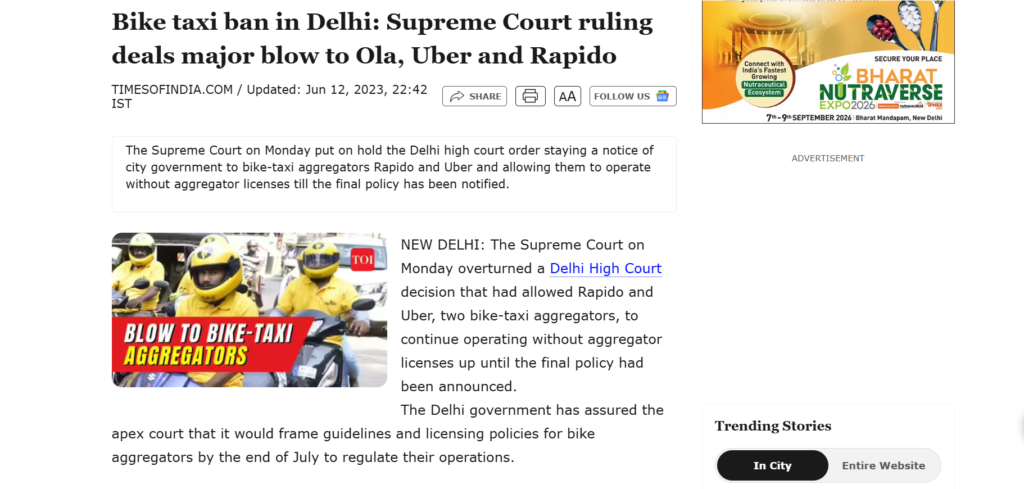
Delhi’s transportation landscape has seen major changes with the growing popularity of app-based cab and bike taxi services. Bike taxis offered commuters an affordable and convenient way to travel through busy roads and traffic.
However, the legal status of bike taxis became a major issue after the Delhi government restricted their operation. The matter eventually reached the Supreme Court, which directed that bike taxis operated by aggregators such as Ola, Uber and Rapido could not continue in Delhi until the government framed the required regulatory policy.
The development created uncertainty for bike-taxi riders, passengers, aggregators and the wider commercial mobility industry.
What Was the Delhi Bike Taxi Ban About?
The dispute primarily revolved around whether privately registered two-wheelers could legally be used for commercial passenger transportation through app-based aggregators.
The Delhi government argued that bike taxis required appropriate registration, permits and regulatory approval under the Motor Vehicles Act and the applicable aggregator framework.
The issue was not simply about Ola, Uber or Rapido. It raised a broader question about how app-based transportation services should be regulated and how commercial passenger vehicles should be registered and licensed.
What Did the Supreme Court Say?
In June 2023, the Supreme Court stayed the Delhi High Court order that had temporarily allowed bike-taxi aggregators to continue operating while a policy was being formulated.
The Supreme Court’s position meant that bike taxis could not operate in Delhi until the required policy and regulatory framework was put in place. The Delhi government had indicated that it was working on a final policy for aggregators.
This gave regulators greater authority to determine the conditions under which bike taxis could legally operate.
Impact on Ola, Uber and Rapido
The decision represented a significant setback for app-based bike-taxi services in Delhi.
1. Ola
Ola’s bike-taxi operations were affected by the restrictions because two-wheelers used for commercial passenger transportation required appropriate regulatory approval.
2. Uber
Uber’s bike-taxi services also faced restrictions in Delhi. The Supreme Court’s intervention meant that the company could not rely on the earlier Delhi High Court relief to continue operations without the required policy framework.
3. Rapido
Rapido, one of India’s prominent bike-taxi platforms, was also directly affected. The company had challenged restrictions on its operations along with other aggregators.
The case highlighted the importance of proper registration, permits and compliance for app-based commercial transportation services.
Why Is Regulation Important for Bike Taxis?
The bike-taxi debate highlights several important issues:
- Passenger safety
- Commercial vehicle registration
- Insurance coverage
- Driver licensing
- Vehicle permits
- Aggregator licensing
- Road safety and traffic management
- Accountability of ride-hailing platforms
Similar regulatory questions have continued to appear in other states as governments and courts examine how motorcycles can legally be used for passenger transportation. For example, the Karnataka government has recently raised safety, insurance and regulatory concerns before the Supreme Court in relation to bike taxis.
What Does This Mean for Taxi Owners?
The bike-taxi controversy also highlights an important opportunity for traditional taxi and commercial vehicle operators.
Cars and other properly registered commercial vehicles continue to play a crucial role in Delhi-NCR’s mobility ecosystem. Businesses and individual operators looking to enter the taxi industry need to focus on:
Proper commercial registration + appropriate permits + insurance + regulatory compliance.
For people planning to start or expand a taxi business, choosing the right commercial vehicle can make a significant difference in operating costs and long-term profitability.
Commercial Cabs: An Alternative for Taxi Business
For entrepreneurs looking to enter the commercial transportation industry, purchasing a suitable taxi can be a practical option.
At Micky Motors – Taxiyan Da Adda, customers can explore commercial taxi and cab options suitable for different business requirements.
From new taxi cars to commercial cabs, buyers can compare available vehicles based on budget, fuel efficiency, passenger capacity and intended usage.
If you are searching online for:
- Cabs for sale in Delhi NCR
- Commercial cars for sale
- New cab cars
- Taxi cars for sale
- New cars for taxi business
- WagonR taxi for sale
- Dzire taxi for sale
- Commercial vehicles for sale
- CabX
- CabXchange
- CabXpert
Micky Motors can be a useful destination to explore available commercial vehicle options.
What Should Taxi Buyers Check Before Purchasing?
Before purchasing a vehicle for commercial taxi operations, buyers should consider:
Vehicle Registration
Make sure the vehicle is eligible for the intended commercial use and has the required documentation.
Insurance
Commercial vehicle insurance is essential for vehicles being used for passenger transportation.
Running Cost
Fuel efficiency and maintenance costs can significantly affect the profitability of a taxi business.
Passenger Comfort
For regular city and outstation operations, passenger comfort should be an important consideration.
Resale Value
Popular commercial vehicles generally have better demand in the used-car market, which can help when upgrading the vehicle later.
The Future of App-Based Mobility in Delhi
The Delhi bike-taxi controversy demonstrates that technology and transportation regulation need to evolve together.
Ride-hailing platforms have changed the way people book taxis and other transportation services. At the same time, governments need to ensure that vehicles, drivers and aggregators operate within a clearly defined legal and safety framework.
As policies develop, the future of bike taxis in Delhi will depend on regulatory decisions, licensing requirements, vehicle classification and safety standards.
For taxi entrepreneurs, however, the larger lesson is clear: compliant commercial vehicles and properly structured taxi businesses remain an important part of urban mobility.
Final Thoughts
The Supreme Court’s intervention in the Delhi bike-taxi matter was an important development for India’s app-based transportation industry. The ruling highlighted the importance of having a clear regulatory framework before commercial passenger services operate at scale.
For people planning to enter the taxi business, the focus should remain on legal compliance, reliable commercial vehicles, operating costs and customer safety.
If you’re looking for cabs for sale in Delhi NCR or commercial taxi vehicles, Micky Motors – Taxiyan Da Adda can help you explore suitable options for your taxi business.
Micky Motors – Taxiyan Da Adda
Your destination for commercial cabs and taxi vehicles in Delhi-NCR. : https://share.google/0GMeEP5WGNXVHjuUu